Open Wire Calculator
home: ky8d.net/free
For both 2- and 4-wire transmission line!
Main Tab
|
MHz Tab
|
Pipe Tab
|
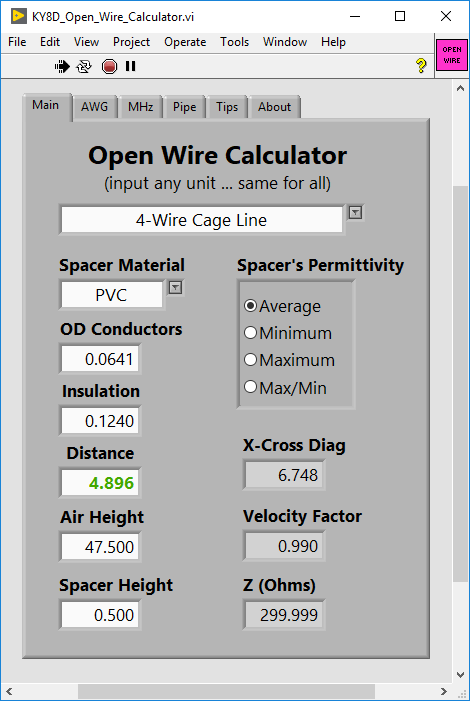
Above screenshots show 300Z quad-wire open transmission line:
- Four parallel 14GA wires
- Square arrangment.
- Stretched very taught, as quad-line hates slackness.
- A half-inch wide spacer every 4 feet.
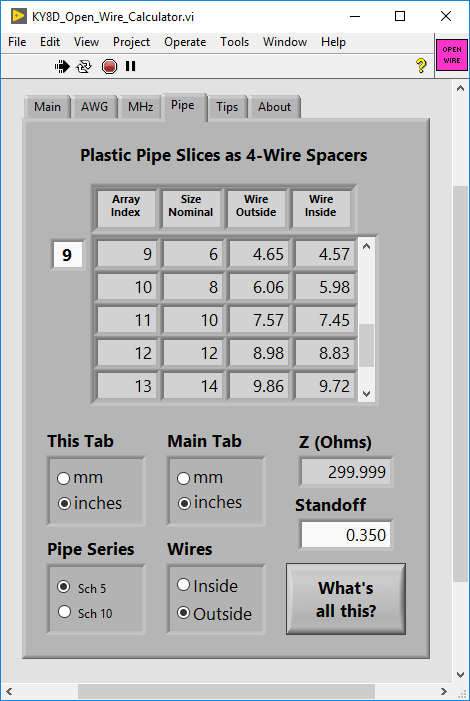
- Rings sliced from 6-inch Sch-5 PVC pipe (per row 9 of table & radio button bottom-left).
- Calculation likewise supports metric PVC pipe per the DIN standard.
- Wires on outside of ring, versus inside (per column 3 of table & radio button bottom center).
- Each with four standoffs, 0.35 inches tall.
- Caliper span between two wires of any side is 4.896 inches.
- Green because "Pipe" tab has control of that input.
- Caliper span diagonally is 6.748 inches.
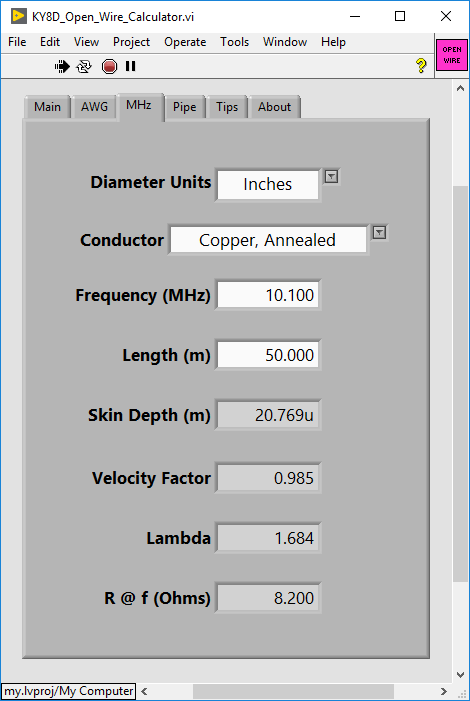
- With a 0.985 velocity factor.
- Representing 1.684 wavelengths for 50-meter span.
- 8.2 Ohms total resistance over a 50-meter there-and-back span.
So, if you're into serious overkill ... go with quad-wire cage-type transmission line just like they do at Point Reyes, CA.
-
User Hints ↑ ↓
Below is a brief list of the input/output widgets. In the program itself, right-click any, then choose Discription and Tip for a reminder.
While program runs, change any value. Answers re-calculated on the fly. Type in values directly, or click any digit, and scroll its value using the up/down arrow keys. Easy peasy. Stop running by way of the red stop sign. Black arrow turns white. Re-start by clicking on the white arrow.
Cage type takes measurements same as for ladder line, across the flat, not the diagonal. Assumed is that the cage will be square, not rectangular.
-
Main Tab ↑ →
-
Ladder or Cage?: Choose if wanting to calculate 2-wire or 4-wire type.
-
Diameter: Size of each conductor, both being equal.
-
Distance: Spacing, center-to-center of conductors.
-
Air Height: Height of window (if window line) when held line hangs vertically.
- If not window line, then the vertical spacing between spreader rungs.
-
Spacer Height: Same as above, but for the spacer (usually plastic).
- If not window line, then the diameter or width of spreader rungs.
- Ratio of air-gap to spacer, no matter how thin the rungs, affects impedance to some degree.
-
Spacer Material: Choose type of plastic from menue.
-
Spacers’s Permittivity: Some plastics have a wide range. Choose what to see.
-
Insulation: Diameter of insulation around conductor, if any.
-
Spacer Width: Caliper distance between conductors, insulated or bare.
-
Z (Ohms): The impedance
-
MHz Tab ← ↑
-
Diameter Units: Whatever units were used on the Main tab.
-
Conductor: Whatever kind of wire you are using.
-
Frequency (MHz): To compensate for skin effect.
-
Length (m): How long of a feedline run?
-
Skin Depth (m): Varies with material and frequency. Shown in SI units: m, n, u, p.
-
Velocity Factor: I'm sure you know what it’s for.
-
R @ f (Ohms): Skin-effect compensated resistance, out and back both combined.
You’ll need two things for it to run: my *.exe application itself, plus also the interpreter program on which it runs. Kind of like Java that way, except that the Java interpreter is probably pre-installed on your system. The LabVIEW run-time engine will not be.
- Download 1st: LabVIEW Runtime Engine
- This is the interpretor program.
- Or, should it please you, the entire LabVIEW programming environment.
- Link back to
ky8d.net/free where I give download instructions.
- Download 2nd: ZIP
-
Important! Best to employ a stand-alone
ZIP archive software (like 7-Zip ) for extracting the *.exe file. Otherwise, Windows will issue dire warnings of an unrecognized app. Once extracted from out of its archive, however, Windows will know to pass it off to the LabVIEW Run-Time Engine instead.
- Source Code, for any who want it.
- Do with my LabVIEW code just as you please. Credit me or not as you choose. Do please pass along any credit I’ve given to other sources.
-
Source Code The LabVIEW source code.
Latin for “Let the moocher beware”. I designed this for me, and used it with glee. I share it here with you for free, but offered without even so much as the smell of a dead warrantee (or wheriot, as the case may be). Whatsoever disasters of cosmic proportion as may result from the use of this program, any and all culpability rests wholly and solely with the user.